Corporate Footprinting for Complex Value Chains
Create audit-ready corporate inventories for Scope 1, 2 and 3 emissions and other environmental impacts to support reporting and guide action toward sustainability targets.
Large companies need reliable environmental data to make credible sustainability commitments, meet disclosure expectations, and respond to growing stakeholder demand. However, complex supply chains and limited supplier data make this a major challenge.
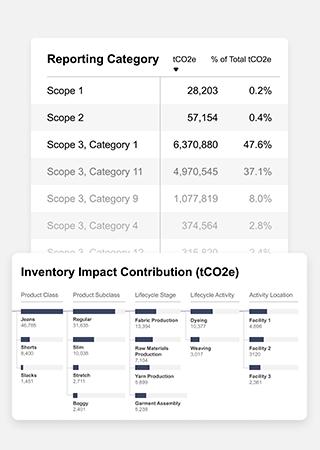
AITrack helps you measure Scope 1, 2 and 3 greenhouse gas (GHG) emissions, water stress and other environmental impacts across direct operations and supply chains, supporting transparency and auditability. By integrating product-level lifecycle assessments (LCAs) into corporate footprinting, AITrack enables you to pinpoint granular hotspots, take targeted action, and meet global reporting requirements.
How AITrack supports corporate footprinting
AITrack in action
Case study: Fortune 500 food & beverage company
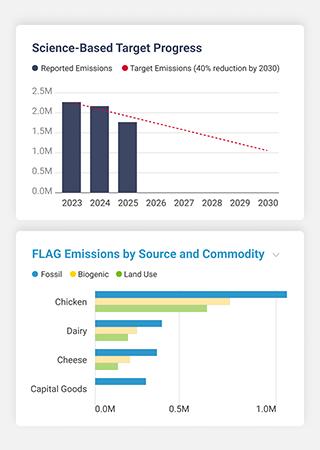
A global food and beverage leader partnered with AITrack to transform spend-based estimates into activity-based GHG inventories. This provided granular visibility into value chain emissions, enabling SBTi FLAG target tracking and climate risk assessment.
AITrack helped this company:
- Identify emissions hotspots and mitigation opportunities across complex value chains
- Streamline primary data collection from 100+ countries
- Provide 200+ users with role-based access to tailored insights into the company’s Scope 1, 2 and 3 emissions and climate-related risks.
What sets AITrack apart for corporate footprinting
- Integrate corporate and product insights: We build corporate inventories from product-specific LCAs at scale, helping you identify impact drivers across your value chain and prioritize the activities, components, materials, suppliers, and locations with the greatest potential to improve your footprint.
- Start where your data is: We work with your current data, even if it is incomplete or unstructured, and help you improve data quality and sophistication over time.
- Deliver expert support from data to disclosure: We combine AITrack’s software and data foundation with LCA and sustainability expertise to help you strengthen inventory quality and prepare for assurance, SBTi submission, and reporting.
Explore the integrated data, software, and expertise behind AITrack
Related AITrack Solutions



Frequently asked questions
-
Why is Scope 3 emissions tracking important for large companies?
Scope 3 emissions often make up the majority of a company’s total footprint. In some sectors, they reach over 90%. Tracking value chain emissions helps large companies meet regulatory requirements, including EU CSRD and California SB 253, and support ISSB/IFRS S2-aligned disclosures. It also supports SBTi target setting and progress tracking, helps respond to stakeholder and customer pressure, and enables companies to prioritize the highest-impact suppliers, products and activities as they build credible transition plans.
-
How does AITrack calculate Scope 3 emissions across complex value chains?
AITrack calculates Scope 3 emissions by building corporate GHG inventories across all Scope 3 categories using a flexible, hybrid LCA approach. We use custom activity-based LCA models for all high-impact items and integrate supplier-provided data where available. This provides granular insights across the product portfolio and supply chain network. Spend-based estimates are used to fill remaining gaps while maintaining auditability across the full corporate inventory.
This approach enables companies to identify emissions hotspots and track measurable progress toward targets, informing effective decarbonization actions. -
What data can AITrack use to calculate corporate carbon footprints?
AITrack uses primary data from clients and suppliers, including bills of materials (BoMs), manufacturing data, supplier surveys, product specifications, environmental product declarations (EPDs), purchase orders and other operational inputs. Data can be collected through API integrations, file uploads or AITrack’s Supply Chain Engagement solution. Through this solution, suppliers can provide existing LCA or PCF results with linked documentation, or calculate the impacts of their own products.
AITrack also draws on its own industry-leading LCA activity database, covering 500K+ industrial, energy, and agricultural activities from 300+ sources. Even with incomplete or unstructured data, AITrack’s automated pipelines and expert support help clients standardize and scale workflows over time. -
How long does it take to receive the first corporate footprint results?
The first corporate footprint results are typically available within 2–6 months, depending on the complexity of the value chain, number of products, primary data availability and reporting needs. AITrack supports rapid development of custom activity-based LCAs at scale. Our experts help fill data gaps and generate quality results in time for reporting deadlines. The process is collaborative and iterative, so results improve as data quality and coverage increase.
-
How does AITrack support science-based target setting and progress tracking?
AITrack helps companies efficiently set and track science-based targets for SBTi, including forest, land and agriculture (FLAG) targets. The process starts with a granular Scope 1, 2 and 3 GHG inventory for all material categories, which helps organizations address key SBTi requirements and determine whether FLAG targets are needed.
AITrack works with you to define each target’s boundary, timeframe, and method, in line with your company’s ambition and SBTi standards and guidance. We also support client documentation from the commitment letter through final validation submission.
Once targets are set, AITrack enables you to track year-on-year progress, identify emissions hotspots, and prioritize mitigation actions through our Mitigation Strategy solution. AITrack also supports new target setting and updates to existing targets. With streamlined calculations and automation, rebaselining past inventory years can be completed more efficiently, reducing timelines from months to days. -
How does AITrack support assurance readiness?
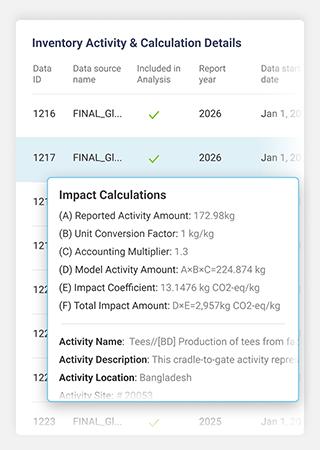
AITrack supports assurance readiness by making corporate footprint data transparent, traceable, and easy to review. Our system automatically timestamps data transactions, tracks user-platform handoffs, and generates audit trails with full versioning.
Auditors are given specialized user rights to view an interactive report tailored to the assurance process, showing the primary data sources, calculation steps, methodologies, and line-item results. AITrack also offers optional pre-assurance reviews to identify potential issues before formal assurance engagements, to reduce risk and streamline the process. -
Does AITrack support reporting for wider environmental impacts beyond carbon?
Yes. AITrack supports assessment for water stress, biodiversity and other environmental impacts, in addition to GHG emissions. By combining life cycle inventory data with science-based impact assessment methods, AITrack helps companies prepare for evolving frameworks such as the Taskforce on Nature-related Financial Disclosures (TNFD) and Science Based Targets Network (SBTN). It also helps clients reduce blind spots by providing a broader view of environmental priorities.
-
How does AITrack support enterprise data security and access control?
AITrack includes an Azure cloud-based platform built for enterprise-grade cybersecurity and data protection. It is SOC 2 Type 2 and ISO 27001 certified, supports single sign-on (SSO), and gives clients full control to customize access rights based on user roles. AITrack’s proactive security control ensures that only authorized users can view, edit, or approve data across teams and workflows, while keeping data secure.